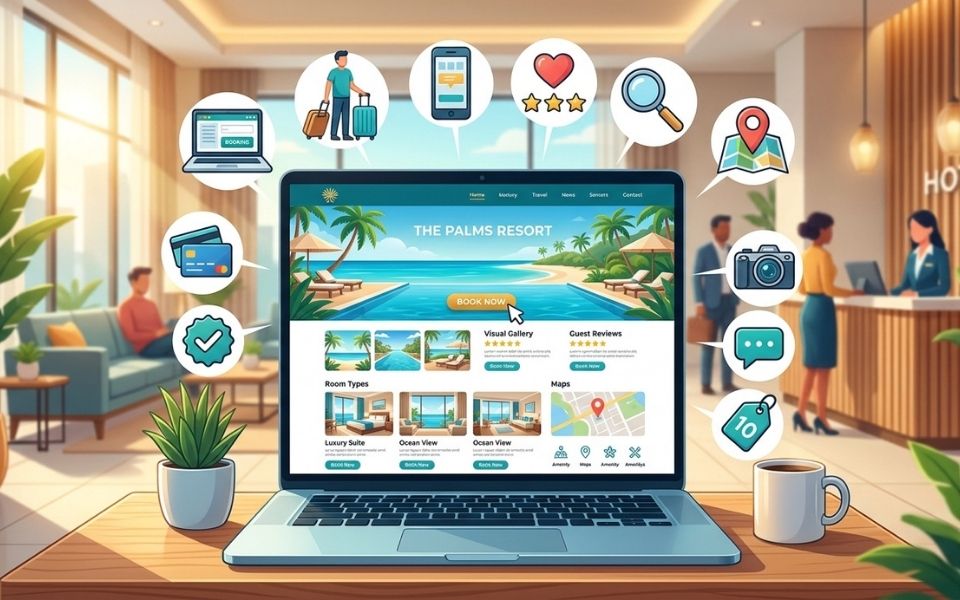
In today’s digital era, a hotel website is no longer just a platform to showcase the property. For many travelers, the official website can play an important role in determining whether they continue with a booking or choose another hotel.
Although Online Travel Agents (OTAs) remain one of the main sources of hotel reservations, more hotels are now focusing on driving direct bookings through their own websites. Besides reducing dependency on third-party platforms, direct bookings can provide better profit margins and create opportunities to build long-term relationships with guests.
However, simply having a website is not enough. A hotel website needs to provide a convenient experience, make the booking process easy, and build trust with potential guests.
So, what elements should a hotel website have to effectively generate more bookings?
Why Is a Hotel Website Important for Increasing Bookings?
A guest’s booking journey often starts with an online search. Travelers typically compare several hotels based on location, facilities, room rates, and reviews from previous guests.
The official hotel website is often considered a trusted source of information because the details come directly from the hotel. If the website looks professional, is easy to navigate, and provides a smooth user experience, the chances of a guest making a reservation can increase.
On the other hand, a website that is slow, difficult to navigate, or lacks important information can make potential guests lose confidence before completing their booking.
That is why a hotel website should be viewed as a marketing and sales asset, not simply as an additional digital presence.
1. Professional Design That Reflects the Hotel’s Identity
First impressions are formed within seconds. A modern, clean, and consistent website design can help build trust with potential guests.
The website design should reflect the hotel’s character. For example, a luxury resort may use an elegant design with large, high-quality visuals, while a business hotel may focus on a clean, professional, and informative layout.
Beyond visual appeal, the design should also make it easy for visitors to find the information they need.
2. Mobile-Friendly Design
Many potential guests now search for hotels using their smartphones. If a website is difficult to use on mobile devices, the hotel may lose potential bookings.
A responsive website automatically adjusts its layout to different screen sizes, allowing visitors to browse comfortably without excessive zooming or horizontal scrolling.
Google also considers mobile user experience as part of its search ranking systems, making mobile optimization important for both usability and SEO.
3. Easy-to-Use Booking Engine
A good hotel website should not only provide information but also allow guests to make a reservation directly.
The booking engine should offer a simple process, from selecting travel dates and room types to completing payment.
The fewer steps users have to go through, the higher the possibility that they will complete their booking.
It is also important to ensure that room rates and availability are updated in real time to avoid confusion and provide an accurate booking experience.
4. Complete and Clear Room Information
One reason potential guests may abandon a booking is a lack of information about the available rooms.
- Each room type should ideally include:
- Room size
- Bed type
- Maximum occupancy
- Available facilities
- Photos from different angles
- Room view information
The more complete the information, the easier it is for potential guests to choose a room without having to contact the hotel first.
5. High-Quality Photos and Videos
In the hospitality industry, visuals play a major role in influencing booking decisions.
Professional photos can give potential guests a better idea of the experience they can expect during their stay. Besides guest rooms, hotels should showcase public areas such as the lobby, restaurant, swimming pool, meeting rooms, spa, fitness center, and other facilities.
If possible, adding short videos or a virtual tour can also help potential guests experience the hotel more realistically before making a reservation.
6. Clear Call-to-Action (CTA)
Many hotel websites have attractive designs but fail to provide clear direction to visitors. Make sure buttons such as:
- Book Now
- Check Availability
- Reserve Now
- Contact Us
are easy to find throughout the website.
Strategically placed CTAs can help shorten the decision-making process and increase the chances of visitors making a reservation.
7. Optimal Website Speed
Website speed is often overlooked, even though it has a significant impact on user experience.
A website that takes too long to load can cause visitors to leave before they even see the information available. Some ways to improve website speed include:
- Optimizing image sizes
- Using reliable hosting
- Minimizing unnecessary scripts
- Performing regular website maintenance
A fast website not only provides a better user experience but can also support the hotel’s SEO performance.
8. Guest Testimonials and Reviews
Before booking a hotel, many travelers look at the experiences of previous guests to help them make a decision. Displaying positive reviews, awards, and ratings from various platforms can increase the hotel’s credibility. Make sure the testimonials come from genuine guests and are updated regularly to remain relevant.
This type of social proof can help potential guests feel more confident about completing their reservation.
9. SEO Optimization to Improve Google Visibility
An attractive website will not deliver maximum results if potential guests cannot find it on Google.
That is why SEO optimization is an important part of increasing a hotel website’s visibility in search engines.
Some SEO strategies include:
- Using relevant keywords
- Creating informative blog content
- Optimizing meta titles and meta descriptions
- Using a clear heading structure
- Improving website speed
- Optimizing images
With the right SEO strategy, a hotel website has a better chance of appearing when potential guests search for hotels based on their preferred location or travel needs.
10. Integration with Other Digital Channels
A hotel website should not operate as a standalone platform. Instead, it should be connected with the hotel’s broader digital marketing ecosystem.
Integrating different channels can create a better user experience while making reservations and inventory easier to manage. Some important integrations include:
- Online Travel Agents (OTAs)
- Google Maps
- Social media
- Booking engine
- Channel manager
When these systems are properly connected, information such as room rates, availability, and reservations can be updated more efficiently.
Common Mistakes Still Found on Hotel Websites
Despite having a website, many hotels still do not use it to its full potential. Some common problems include:
- An outdated and unprofessional website design
- Outdated room information
- A complicated booking process
- No clear reservation button
- Slow website loading speed
- Low-quality photos
- Poor mobile responsiveness
Lack of an SEO strategy, making the website difficult to find on Google
These issues can reduce guest confidence and directly affect the number of reservations a hotel receives.
In an increasingly competitive hospitality industry, having a well-optimized website can be a valuable long-term digital investment for hotel businesses.
If you want to develop a hotel website that is not only visually appealing but also designed to generate more direct bookings, Ecommerceloka can help. From hotel ecommerce management and OTA optimization to pricing strategies, online visibility, and data-driven hotel marketing strategies, we help hotels maximize their sales potential in the digital era.