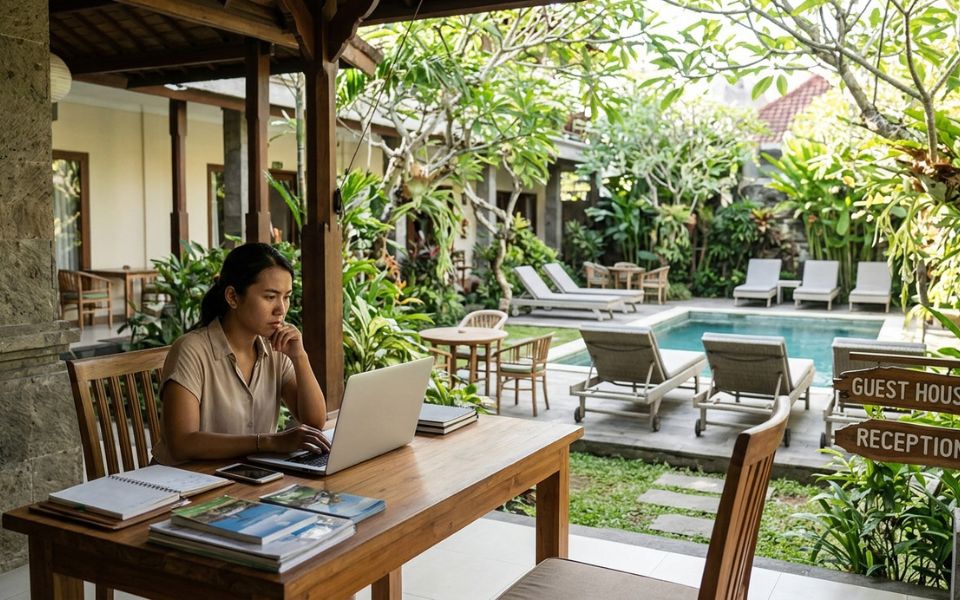
An empty guest house does not always mean that the room rates are too high. Many factors can contribute to low occupancy, from poor visibility on OTAs and unappealing photos to pricing strategies that do not match the market and a lack of information that makes it difficult for potential guests to find what they need.
For guest house owners, this is something that needs attention. Every empty room represents potential revenue that could be missed. The good news is that most of these issues can be addressed with the right marketing strategy.
Why Is Your Guest House Empty?
Before changing your marketing strategy, it is important to understand the reasons behind the low occupancy. Here are some of the most common issues.
1. Your Guest House Is Difficult to Find on OTAs
Today, many travelers search for accommodation through Online Travel Agencies (OTAs) such as Traveloka, Tiket.com, Booking.com, Agoda, and other platforms.
If your guest house rarely appears in search results, the chances of getting bookings will naturally decrease. This can be affected by factors such as ratings, number of reviews, room rates, listing information, photos, and overall listing performance.
That is why OTA management is not simply about adding room rates. Your listing needs to be regularly optimized to remain competitive.
2. Your Room Photos Are Not Appealing Enough
Potential guests cannot see your guest house in person before making a booking. Photos are therefore one of the key factors they consider.
Dark, outdated, or limited photos can make potential guests choose another property instead. Make sure your photos clearly showcase the rooms, bathrooms, common areas, facilities, entrance, and other attractive features of the guest house.
3. Your Rates Do Not Match the Market
Rates that are too high can cause potential guests to choose competitors. However, simply lowering your rates does not necessarily guarantee more bookings. What matters more is understanding competitor rates in the area, peak and low seasons, weekdays and weekends, and demand during specific periods. Your pricing strategy should be flexible rather than using the same rates throughout the year.
4. Your Reviews and Ratings Are Still Low
Reviews can have a significant impact on a guest's booking decision. A guest house with a high rating and positive reviews is generally more convincing than a property with very few reviews or multiple complaints. Besides encouraging guests to leave reviews after their stay, property owners should also pay attention to recurring complaints. These could include issues with cleanliness, Wi-Fi, service, or room facilities.
5. There Is No Consistent Marketing Strategy
A guest house should not rely solely on OTAs. Marketing should be done across multiple channels so potential guests have more opportunities to discover the property. These channels can include Google Business Profile, Instagram, TikTok, a website, Google Ads, and OTA promotions. This is why hotel and accommodation marketing strategies need to be tailored to the property's target market and location.
How to Increase Guest House Bookings
Once you understand the possible causes, here are several steps you can take.
1. Optimize Your OTA Listings
Review all the OTAs you currently use. Make sure the property name, description, facilities, photos, room types, policies, and rates are up to date. Use clear titles and descriptions so potential guests can immediately understand what makes your guest house different.
For property owners in Bali who want to improve their OTA management, working with a Bali OTA management service can also be an option, especially if you do not have a dedicated team to manage your OTA channels.
2. Update Your Photos and Content
You do not always need a major renovation. Sometimes, simple improvements such as taking new photos with better lighting can make your listing look much more attractive. Also highlight features that travelers may be looking for, such as:
- Close to the beach or tourist attractions
- Near restaurants and local dining spots
- Free Wi-Fi
- Swimming pool
- Parking
- Airport transfer
- Breakfast
- Workspace
3. Create a Flexible Pricing Strategy
Try using different rates based on the period. For example, rates can be more competitive during weekdays or low season, while rates can be adjusted during high season when demand is higher. Promotions such as early booking deals, last-minute offers, long-stay discounts, or limited-time promotions can also help increase occupancy.
4. Monitor Your Competitors
Do not only look at your own rates. Check several guest houses and hotels that compete directly with your property. Compare:
- Room rates
- Ratings
- Number of reviews
- Photos
- Facilities
- Promotions
- Overall value
This can help you determine whether your guest house is overpriced, lacks value compared to competitors, or has advantages that are simply not being communicated effectively.
5. Maximize Your Google Business Profile
Not every potential guest searches for accommodation through an OTA. Some travelers use Google to search for terms such as "guest house in Bali," "guest house near Ubud," or searches based on a specific location.
Make sure your Google Business Profile includes complete information, updated photos, opening hours, contact details, and active customer reviews.
6. Use Marketing Channels Beyond OTAs
OTAs are important, but they should not be your only source of bookings. Guest houses can also generate traffic through Instagram, TikTok, Google Search, their own website, and other channels.
A website can be a valuable asset because it allows potential guests to access complete information about the property and make direct bookings without always relying on OTAs.
Does a Guest House Need an Ecommerce Strategy?
Hotel ecommerce management is not just about making your property available on OTAs. It also involves managing room distribution, pricing, promotions, sales channels, and the performance of each channel.
For guest houses that already use multiple OTAs, a more structured approach can help reduce manual work and make it easier to monitor and improve sales strategies.
However, every property has different needs. A small guest house with a limited number of rooms may need a much simpler strategy than a hotel with dozens or hundreds of rooms.
When Should You Consider Professional Help?
If occupancy remains low even after your rates are competitive, your photos have been updated, and your listings are active across multiple OTAs, the problem may not simply be pricing.
There may be issues with your distribution strategy, positioning, content, or overall marketing approach.
At this stage, property owners may consider working with an agency or consultant that understands hotel ecommerce, OTA management, digital marketing, and the local market.
Ecommerceloka helps properties manage and optimize their digital channels with an approach tailored to each property's needs.